

Hub-coupled powertrain test bench
OEMs and suppliers are actively developing systems and components for innovative electric vehicle (EV) powertrain system concepts. Historically, the key driving forces behind these developments were drivetrain designs, including manual, automatic, and dual-clutch systems utilized in both two-wheel drive (2WD) and four-wheel drive (4WD) powertrains.
However, the current shift towards fully electric driveline systems is dramatically transforming the design of drivetrain architectures. High-voltage components, such as electric drives, have become essential in this evolution. To support this transition, customers require a robust powertrain test bench capable of evaluating and optimizing both high-voltage electrical and mechanical subsystems, ensuring that they meet the rigorous demands of development and system integration.
Moreover, a powertrain test bench equipped with steering capability is crucial for conducting vehicle-in-the-loop (VIL) testing. This type of testing creates a realistic test environment that is vital for validating the functionalities of advanced driver assistance systems (ADAS) and automated driving (AD) technologies in real vehicles. The integration of steering functionality within the hub-coupled powertrain test bench allows for comprehensive assessments that mimic actual driving conditions, ensuring that all systems work together harmoniously.
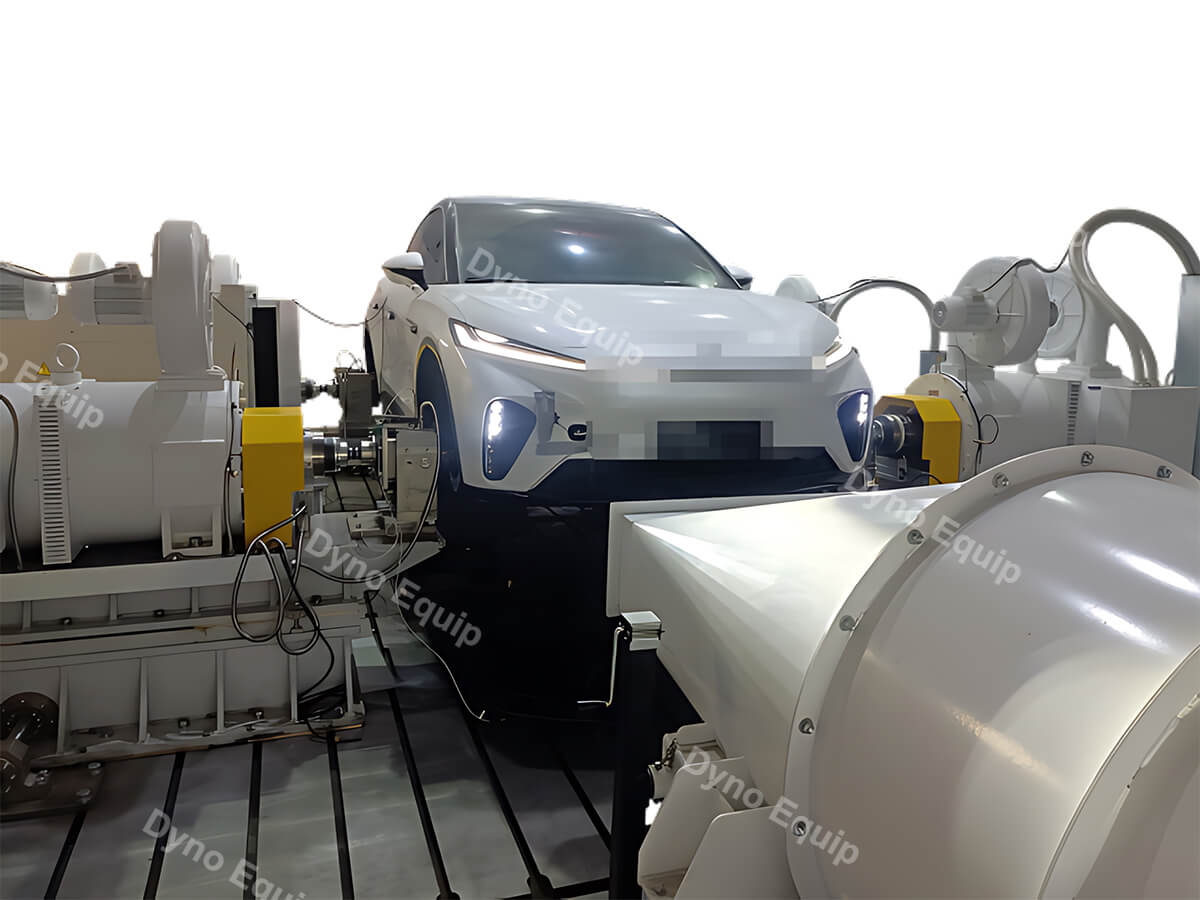
The hub-coupled electric powertrain test bench is specifically designed to oversee the intricate verification processes for both ICE-powered vehicles and electric vehicles, including fuel cell, hybrid, plug-in, and battery electric vehicles (BEVs), during their development phases. This versatility is essential for manufacturers looking to ensure performance and reliability across a wide range of powertrain types.
DynoEquip excels in building test rigs tailored for passenger cars, light-duty trucks, heavy-duty trucks, buses, tractors, and off-road vehicles. By offering solutions throughout the entire development process, DynoEquip supports a variety of applications. Powertrain testing typically involves conducting durability tests to confirm that drivetrain components meet their designated lifespan requirements, as well as performance evaluations that include consumption analysis, emission testing, and electrical driving range optimization.
Additionally, drivability optimization and the integration of high-voltage (HV) components are essential aspects of this process. The test benches also facilitate failure diagnostics and on-board diagnostics, along with safety-critical tests to identify any unforeseen interactions that might lead to undefined operating conditions.
At the core of the hub-coupled electric powertrain test benches are modern, well-researched products, ranging from automation software that supports a wide array of applications to load machines designed for various power classes. DynoEquip’s expertise in system integration and application knowledge significantly enhances customer efficiency, providing tailored testing solutions that meet specific client demands. This comprehensive approach ensures that manufacturers can effectively develop and validate their electric powertrain systems, paving the way for advancements in sustainable transportation.
Portable axle-mounted dynamometer
Portable axle-mounted dynamometers have become vital tools in the automotive industry for testing powertrain performance, as they effectively meet the increasing demand for flexibility and precision in vehicle testing. These dynamometers enable engineers to assess vehicle performance metrics such as power and torque in various locations, whether in workshops or within environmental chambers. This adaptability allows for efficient testing during different stages of vehicle development and evaluation, ensuring that manufacturers can optimize performance while ensuring compliance with regulatory standards.
The application of portable axle-mounted dynamometers in environmental chambers significantly enhances the ability to evaluate vehicle performance under controlled conditions. Environmental chambers are designed to simulate a variety of climatic scenarios, such as extreme temperatures (-40°C to 60°C) and varying humidity levels, which can significantly influence a powertrain’s efficiency and emissions. By integrating dynamometers into these chambers, researchers can conduct performance tests that yield critical insights into how different environmental factors affect vehicle operation. This controlled testing environment is essential for ensuring that vehicles meet emissions and performance standards across various conditions.


Light-duty EV powertrain test bench for performance tests
At the wheel hub of the hub-coupled powertrain test bench, there are typically two or four load machines strategically positioned to facilitate comprehensive testing. Each of these load machines is engineered to deliver impressive output levels, ranging from 220 kW to 500 kW, and they possess a substantial torque range between 3,200 Nm and 7,000 Nm. This capability allows for realistic simulation of the power and performance characteristics that electric vehicles (EVs) encounter during operation.
In an EV powertrain system, the conventional battery is often replaced by a sophisticated battery simulator that can provide up to 1,000 kW of power. This advanced simulator enables engineers to replicate the electrical characteristics and energy delivery of actual battery systems, allowing for thorough testing without the need for physical batteries. By integrating this simulator into the hub-coupled powertrain test bench, various driving circumstances can be accurately recreated, providing a robust vehicle dynamics simulation that reflects real-world driving scenarios. This level of simulation is essential for evaluating the performance, efficiency, and reliability of electric powertrains, ensuring that manufacturers can optimize their systems for the demands of modern transportation..

Asynchronous load machine
| Model | Rated power (kW) | Rated torque (Nm) | Max. speed (rpm) | Inertia (kgm2) |
| ATT1 | 400 | 5,000 | 4,500 | 4.4 |
| ATT2 | 350 | 4,200 | 4,000 | 3.5 |
| ATT3 | 300 | 3,700 | 3,500 | 2.4 |
** Parameters can be changed according to customer needs
Permanent magnetic synchronous load machine
| Model | Rated power (kW) | Rated torque (Nm) | Max. speed (rpm) | Inertia (kgm2) |
| PPT1 | 300 | 4,000 | 3,000 | 0.85 |
| PPT2 | 250 | 3,000 | 3,000 | 0.62 |
** Parameters can be changed according to customer needs
Heavy-duty PHEV powertrain test bench for performance tests
A torque range of up to 20,000 Nm is employed by two, four, or more load machines. Occasionally, matched gearboxes are required to meet the high torque demands of the tested unit. Typically, in a plug-in hybrid powertrain system, the battery is replaced with a battery simulator that can provide up to 1,000 kW. Realistic driving maneuvers are possible thanks to a robust vehicle dynamics simulation.
Electric powertrain test bench for system or HV integration
A fully automated test system including four very dynamic wheel load machines forms the foundation of this hub-coupled powertrain test bench. In addition, several load machines, conditioning devices, and temperature, torque, and rotational speed measurement tools are available. This allows for the quick execution and repetition of a large number of tests. Further testing devices, including high-power HV sinks or sources, voltage and current measuring systems with high sampling rates, and mains simulation, are added to the system to meet the requirements of the validation of the HV electrified driveline system.
For example, the below 4WD hub-coupled EV powertrain test bench can be used for full vehicle evaluation of small city cars to SUVs, as well as system testing.
The test rig incorporates four individual wheel load machines, using four ultra-dynamic asynchronous load machines each rated at 290 kW, 4,200 Nm (+20% overload). Each load machine has a wheel-simulated inertia of 3.5 kgm2 and can reach a maximum speed of 3,000 rpm.

Typical project of chassis control system and powertrain test bench
The bench is used for the development, matching, and certification of various 4WD models.
- Various types of 4WD models (2WD, full-Time 4WD, part-time 4WD, real-time 4WD)
- Power system modes (fuel 4WD, hybrid 4WD, pure electric 4WD, and hub drive)
- 2WD and 4WD compatibility, 2WD or 4WD tests can be carried out
- Can be applied to the test requirements of the hub drive power system
- Coverage of drivetrain and vehicle modes
- The performance and functional strategy test of the whole vehicle for various types of 4WD and 2WD passenger cars

Hub-coupled test stand main functions
- The whole vehicle removes the wheels and goes on the bench for quick matching and testing, providing a virtual actual working environment and road load environment of the whole vehicle, and the controllers of the whole vehicle (powertrain controllers and other controllers of the whole vehicle, such as VCU, BMS, ESP, IPB, etc.) can be linked with the testbed in real time to simulate the various working conditions of the whole vehicle on the road (including the simulation of wheel skidding, and the four-wheeled can be set individually for the coefficient of adhesion);
- Development and matching of EV powertrain systems (4WD and 2WD) of various models, control strategy simulation, dynamic testing, real-vehicle simulation, on-line fault analysis, providing virtual working environment of real-vehicle driveline systems and road load environment. The Simulink model can be imported to simulate the interactive working state of each controller and drivetrain of the whole vehicle, and at the same time interact with the bench in real time;
- The control system can communicate and control directly with the external control model to control the units under test (UUTs) in real-time;
- The system can integrate the user’s control model (with the help of hardware and software and real-time control systems) to control the UUTs in real time;
- The measurement and control system can be compatible with and adaptable to hybrid, conventional fuel, pure electric, and 4WD hub drive various powertrain and vehicle modes. Test rig can provide a variety of configuration systems for users to choose, to adapt to different kinds of drivetrain systems and vehicles;
- Adaptable to both 4WD and 2WD drivelines or complete vehicle compatibility;
- The four-wheel load machine can be controlled separately and individually (speed-torque, or used as a single load machine);
- In 4WD, each load machine torque and speed can be controlled to simulate tires spinning in place;
- Enables independent operation of one wheel while the remaining wheels remain stationary in the case of 4WD hub e-motors;
- Steady-state testing (NEDC) of individual hub e-motors and assemblies can be performed independently;
Vehicle, driving, and road simulation functions
- Vehicle and driving simulation (including wheel slip simulation to simulate wheel skidding and road adhesion coefficient can be set independently), the relevant parameters can be edited and embedded in the automatic working conditions;
- Typical vehicle parameters (mass, axle load, inertia, and other parameters) can be input and edited, and the system provides a set of default values of relevant parameters for typical passenger cars;
- Typical working conditions: NEDC, CLTC, WLTC, and other working conditions cycle;
- Customer road data can be imported (self-programmed data, real-vehicle road load data, etc.);
Typical project of hub-coupled vehicle-in-the-loop test bench
The four load machines vehicle-in-the-loop (VIL) test bench can meet the requirements of pure electric and hybrid passenger car and light truck vehicle system dynamics, economy test, vehicle control system strategy calibration, vehicle durability test, vehicle energy consumption test, vehicle rapid acceleration and deceleration in ejector mode, vehicle limiting speed, vehicle dynamic fault injection, vehicle dynamic gradient loading, vehicle environmental adaptability, and other R&D tests.
The bench can meet the requirements of the system performance test and endurance test. It can be used for two-wheel drive and four-wheel drive pure electric powertrains’ function, performance, environment, and reliability tests. The load machines can simulate the actual driving resistance of the vehicle, and carry vehicle simulation software for vehicle dynamics simulation tests at the drivetrain level.
There are climate chambers that can accommodate both 2WD and 4WD vehicles. Climatic conditions can be simulated from -45°C to +60°C with humidity ranging from 5% to 95%. The climatic testing is similar to that of traditional vehicle chambers to reflect the range of conditions around the world.

Test objects
The four load machines VIL test bench meets the test requirements of pure electric and hybrid passenger cars and light trucks, and the test requirements of 2WD and 4WD powertrain systems.
Testbed major tests
- 2WD drivetrain
- Input and output characteristic tests
- Torque response time
- Efficiency test
- Vehicle road spectrum simulation test
- Comprehensive endurance, high-speed endurance, drive endurance test
- E-otor, oil pump, and controller test
- Temperature rise and heat balance test
- 2WD, 4WD drivetrains, complete vehicle
- NEDC conditions
- WLTP conditions
- CLTC condition
- Skidding test
- Maximum speed simulation test
- 0-100km/h full-throttle acceleration simulation test
- Climbing speed simulation test
- Ramp start ability test
- Entire vehicle
- Vehicle wheel slip simulation
- High and low temperature up and down power function test
- High temperature, low temperature, high SOC, or low SOC dynamics test
- High temperature, low temperature, low-speed hill climbing test
- High- and low-temperature SOC balance and power consumption test
- High temperature, low temperature, rapid acceleration or deceleration test
- High- and low-temperature low-surface calibration test
- High- and low-temperature thermal management system calibration test
- High- and low-temperature range and energy consumption tests under different working conditions
- Calibration test of thermal management system at high and low temperatures
- V2V or V2L discharge test at high and low temperatures
- Vehicle starting performance test
- Vehicle charging and discharging test
Typical project of five-axle powertrain test bench
It is used for off-road wide-body vehicle HEV powertrain matching development tests and verification tests. The drivetrain includes conventional fuel (diesel, natural gas) ICEs as the power source, and electric drive products. UUTs include conventional fuel-powered, electric power, and drive axle.

The test stand can support single-axis, three-axis, and five-axis operations at the same time, or two single-axis operations.
Test stand function description
- Performing developmental and evaluative experiments on ICEs and hybrid powertrains, and performing independent drivetrain tests or tests with power sources;
- Completing the measurement of MT shift force and stroke, AT stall, and other tests. The use of a torque converter, axle, and other different configurations of vehicle driveline can simulate the actual road operating conditions of the vehicle;
- Realization of automatic driving during operation (automatic control of clutch status, automatic gear shift);
- Analyze and study the typical factors affecting the performance of the vehicle, such as gradient, lubricating oil, etc.;
- Realizing the test and evaluation of the peripheral accessories of the power source;
- Realizing the evaluation of power drivetrain system efficiency;
- Realizing the test of clutch performance;
- To test and calibrate the matching of the hybrid power system;
- Dynamically simulate the driving conditions of the whole vehicle on the road;
- Simulation of road load (rolling resistance, grade resistance); simulation of vehicle downhill; road load simulation can be set by at least three methods: formula method, speed – force, speed – time;
- Vehicle braking simulation;
- Simulation of vehicle, axle, and wheel inertia for real-time control techniques, fully electrical simulation (calibration of electrical inertia);
- Direct conversion of the collected road spectrum signal into loading signal and loading test;
- Capable of forward and reverse drive (simulated driving and downhill coasting);
- Adapted to a variety of test rigs according to specific test objects;
- Simulation of hill starts by wheel-side loading.
Sitemap