
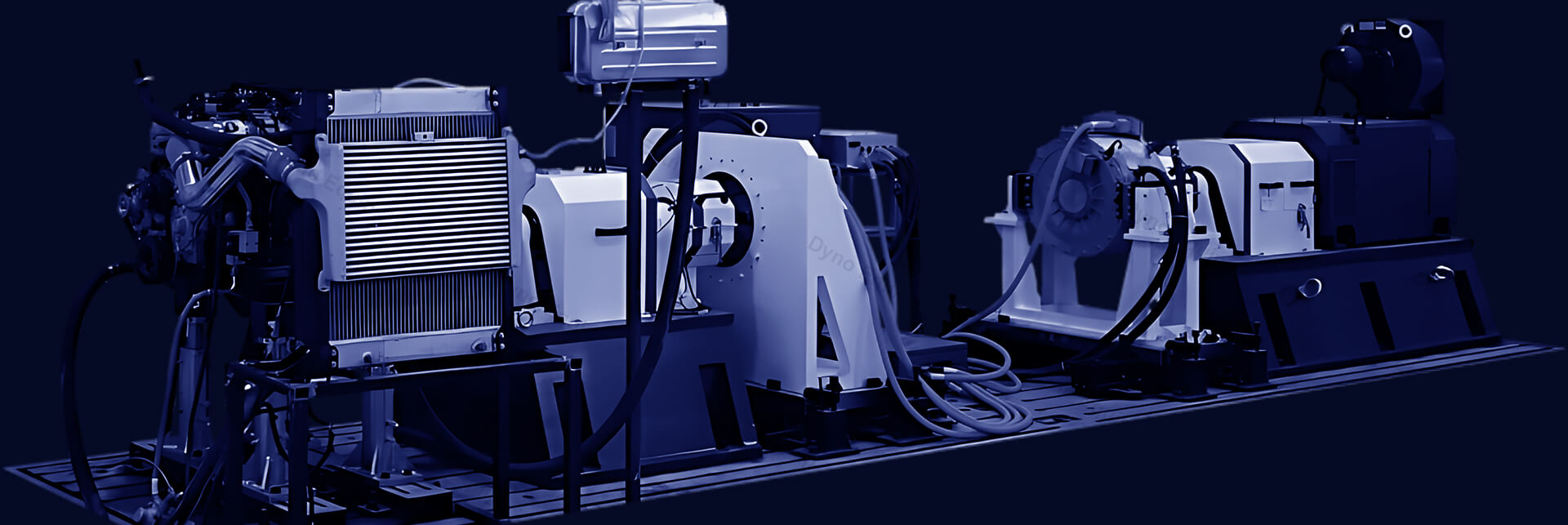
Engine test bench
The hybrid engine test bench from DynoEquip represents an incredibly adaptable development environment tailored for the comprehensive evaluation of various engine types. This advanced testing platform is specifically designed to assess both gasoline and diesel engines, as well as the hybrid components integrated within them. With its precision test and measurement systems, the hybrid engine test bench ensures excellent reproducibility of results, making it an invaluable tool for engineers and researchers working in the field of drivetrain development.
To accurately emulate battery behavior during the testing of the unit under test (UUT), the system incorporates sophisticated battery emulators. These emulators function as either electric power sources or energy sinks, allowing for extremely realistic simulations of battery performance. This capability is critical for the development of hybrid and electric powertrains, as it enables engineers to analyze how the engine interacts with its electrical components under various operating conditions.
Additionally, the test bench supports multi-fuel operation through a dedicated fuel supply infrastructure, which includes conditioning systems and consumption measurement equipment to ensure precise fuel delivery and performance assessment.

The hybrid engine test bench series is fully equipped to handle a wide range of internal combustion engines, from light-duty to heavy-duty applications. This includes off-road vehicles, powered two-wheelers, small engines used in trucks, snowmobiles, motorboats, and even aircraft turbines. The flexibility of the test bench also extends to the evaluation of alternative fuel engines, such as those powered by hydrogen, reflecting the growing demand for sustainable energy solutions in the automotive industry.
One of the standout features of the engine test bench is its modular architecture, which allows for flexible customization to meet the unique testing requirements of different UUTs. This design ensures that any new testing needs can be easily accommodated through future upgrades, making the system highly future-proof. Each test bench is pre-assembled and pre-tested on a mounting plate, facilitating quick and reliable on-site installation that does not require specialized foundations, thus minimizing setup time and costs.
Moreover, the hybrid engine test bench is capable of conducting both steady-state and transient tests, which encompass endurance, functionality, and emission assessments, as well as dynamic simulations essential for fundamental research and development. It also supports specialized applications, including noise, vibration, and harshness (NVH) testing, environmental simulations conducted in climatic or anechoic chambers, and the evaluation of coolants and lubricants.
The containerized approach of the test bench enables versatile setups for both indoor and outdoor testing environments, allowing for a wide range of applications in various settings. This adaptability, combined with its comprehensive testing capabilities, makes the hybrid engine test bench a vital resource for advancing engine technology and ensuring optimal performance across diverse applications.
Test piece: Gasoline engine
| Model | Rated power (kW) | Rated torque (Nm) | Max. speed (rpm) | Inertia (kgm2) |
| AET1 | 500 | 1,200 | 12,000 | 0.7 |
| AET2 | 300 | 1,000 | 12,000 | 0.7 |
| AET3 | 710 | 1,520 | 10,000 | 1.3 |
| AET4 | 250 | 600 | 10,000 | 0.17 |
** Parameters can be changed according to customer needs
Test piece: Diesel engine
| Model | Rated power (kW) | Rated torque (Nm) | Max. speed (rpm) | Inertia (kgm2) |
| AET5 | 900 | 5,000 | 4,500 | 6.6 |
| AET6 | 700 | 3,800 | 4,500 | 3.5 |
** Parameters can be changed according to customer needs

Examples of engine test bench potential applications
- Testing of components
- Aging of catalysts
- Power analysis
- Endurance tests
- Engine mapping
- Steady-state engine testing
- Dynamic-state engine testing
A variety of gasoline engine and diesel engine test benches are provided for use in research and development projects. Among these are:
- Hardware inspection
- Integration of systems, including hybrid components
- Calibration of ECUs and HCUs
- Implementation of hybrid operating approaches
- Optimization of fuel consumption
- Measuring the electric charge
- Testing for steady and dynamic states
- Development and homologation of exhaust emissions
- Optimization of engine response
Commercial vehicle hybrid engine test bench
The commercial hybrid electric vehicle test bench is a vital tool for conducting performance tests on the hybrid systems of new energy electric vehicles. This versatile platform assesses key components, including the engine, controller, and e-motor, facilitating thorough performance research and evaluation during the development stage.
By ensuring that these vehicles meet strict performance and reliability standards before entering the market, the engine test bench plays a crucial role in optimizing vehicle performance.
Equipped with advanced testing capabilities, the engine test bench evaluates the performance and reliability of the electric vehicle engine, drive e-motor, and controller. It identifies potential issues early in the development cycle, allowing engineers to make necessary adjustments.
Additionally, the test bench can be extended to assess the drive e-motor system’s performance, refine controller control strategies, and verify protection functions, ensuring safety and reliability under various operating conditions.
The flexibility of the hybrid electric vehicle test bench enables various testing scenarios, including transient and steady-state evaluations that simulate real-world driving conditions. This adaptability allows manufacturers to validate designs and accelerate the development process, ultimately resulting in high-quality, reliable hybrid electric vehicles that meet customer expectations.

The engine test bench is a highly advanced platform that allows for the seamless importation of tested drive controllers and the entire vehicle’s DBC protocol. This capability enables users to freely define and configure the DBC protocol imports and control function variables, facilitating comprehensive control of the tested controller through the bench system.
Additionally, the system supports the storage of data in various electronic formats, enhancing its versatility. The hybrid engine test bench is specifically designed to meet the demands of “hybrid component commissioning” within the entire vehicle power system, providing the necessary data communication retrieval capabilities for simulation commissioning prior to actual loading.
The equipment features a modular design that emphasizes a straightforward structure, making it user-friendly and easy to maintain. It also includes reserved interfaces for future equipment expansion and maintenance needs. The system employs integrated measurement and control operations, enabling automatic data collection and report generation. With robust statistical data processing functions, the test bench can directly print results or store them in electronic formats such as PDF.
The communication data from the engine test bench is flexible; users can define the ID on the machine, and the data types can be modified to adapt to the evolving requirements of communication protocols. This adaptability allows for continuous improvement and adjustment in response to changing demands.
The engine test bench is instrumental in testing the performance of electric drive systems, providing accurate and reliable test charts and data. It assesses various performance metrics, including power performance, efficiency characteristics, and safety protection functions, ultimately evaluating the overall product performance of the electric drive system.
The main testing capabilities of the commercial vehicle hybrid engine test bench include a comprehensive range of assessments: three-phase DC resistance of the e-motor, AC or DC withstand voltage tests, turn-to-turn tests, no-load tests, power torque tests, temperature rise tests, efficiency tests, blocking tests, overload capacity tests, regenerative energy feedback tests, maximum working speed and overspeed tests, durability tests, and controller control strategy development verification tests.
This extensive array of testing options ensures that manufacturers can thoroughly evaluate and optimize their hybrid systems, leading to improved performance and reliability in commercial vehicles.
Commercial vehicle hybrid engine test bench test items
- Whole vehicle control strategy development and optimization test;
- E-motor external characteristics and efficiency test;
- E-motor drivetrain control optimization;
- Power performance test;
- Test and evaluation test;
- Steady-state road load simulation;
- Hybrid idling driving test;
- Hybrid drive operating mode switching test;

Overall system design overview
Driving system adopted by the measured parts (engine + drive e-motor + generator), by controlling the mechanical energy output of the test piece. Dynamometer measurement and control system with a dynamometer as the core, CAN bus as the main body, through the communication interface board and frequency control unit to load the dynamometer control. Driving bidirectional DC power supply part, electrical parameter measurement using high-precision power analyzer. The control computer completes the control, chaining, operation, and fault diagnosis of the test system test bench. The output of the control computer is transmitted to the data processing computer for data processing through Ethernet.
Sitemap